Why Formula Drift Needed a Fix in the First Place
To understand why Formula Drift built this system at all, you have to go back to a scheduling problem. For two seasons, the PRO Championship used an All-Tandem Seeding Bracket format to set its Top 32 grid, essentially having every driver compete head-to-head just to determine qualifying position. After two years of that format, Formula Drift held driver summits to gauge reaction, and the response split cleanly down the middle of the paddock. Most PRO drivers wanted the old two-run qualifying format back. PROSPEC drivers, who had sharpened their tandem skills under the seeding system, voted to keep it. That left Formula Drift with a genuine puzzle: giving PRO drivers what they wanted meant reintroducing a qualifying format that takes considerably longer to run, and combined weekends, where PRO and PROSPEC share the same limited track time, simply didn’t have room for it. The fix the series landed on wasn’t a compromise on format. It was automation.
Meet UDSM: How the Scoring Actually Works
Formula Drift partnered with Race Data Labs, an Australian telemetry company that had already spent more than three years capturing drift data across 12 countries, to build the Universal Drift Scoring Method, or UDSM. The system breaks a PRO driver’s qualifying score into three components, and the exact math is more specific than most fans probably realize. Line is worth 40 points and is scored entirely by telemetry. Angle is worth another 40 points, also fully automated. That leaves Style at 20 points, the only category still scored by Formula Drift’s three-judge panel. In other words, roughly 80% of a qualifying run’s score never touches a human judgment call at all.
The decision to keep Style separate wasn’t an afterthought. Judging a driver’s flair, commitment, and the difficulty of a run, while also weighing mistakes, requires exactly the kind of nuance a sensor can’t capture. By decoupling it from Line and Angle, Formula Drift gave its judges a narrower, more focused job instead of asking them to balance objective and subjective criteria in their heads during a live event.
Beyond Qualifying: How UDSM Supports Judges in Tandem Battles
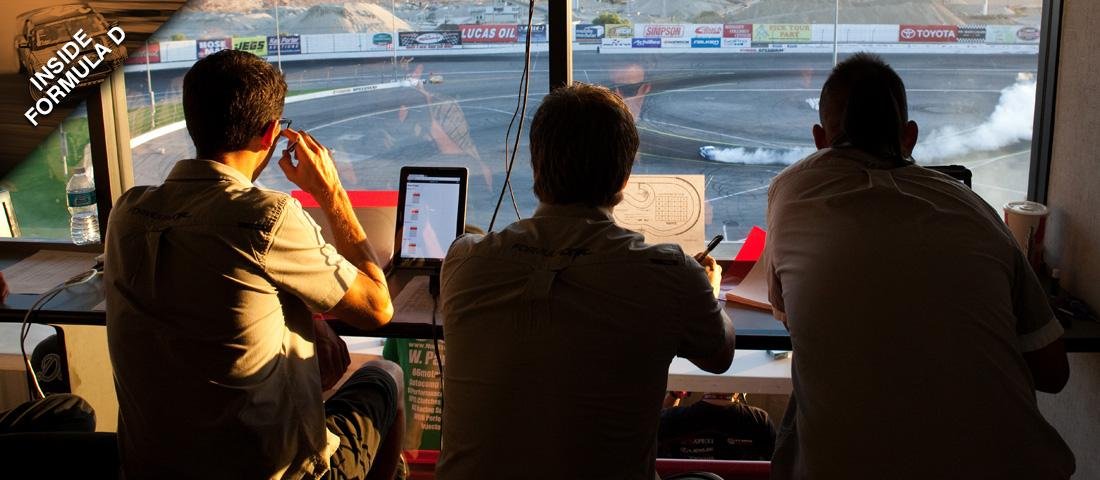
Qualifying is only part of the story. During tandem battles, the head-to-head chase runs that decide the actual bracket, UDSM equips judges with real-time data on proximity between cars, comparative angle and speed, and deceleration patterns that stay accurate even when tire smoke completely obscures the view from the tower. That last piece builds directly on Formula Drift’s existing “Decel Lights” system, adding hard, quantified braking data instead of just a visual cue. The system can also detect exactly how many wheels, one, two, three, or all four, cross outside the marked course boundary, turning what used to be a judgment call into a simple readout.
Crucially, none of this replaces the judges during tandem. It’s designed to inform them, particularly in contact and collision scenarios where determining fault used to rely almost entirely on camera angles and instinct. Formula Drift President Ryan Sage has described the goal as arming judges with data on cars most fans will never fully appreciate at speed, cars producing roughly 1,200 horsepower, without taking the final call out of human hands. That distinction, informing rather than replacing, is doing a lot of work in how Formula Drift has framed this whole rollout, and it’s the same distinction that will likely determine whether drivers and fans ultimately view UDSM as a genuine upgrade or just a more sophisticated way of arriving at the same disputes.
Also for Fans: The Broadcast Angle
UDSM wasn’t built purely to settle disputes behind the scenes. Formula Drift has been clear that a big part of the appeal is bringing much of this telemetry directly into its free livestream broadcast, layering animated, real-time performance data over competition runs so viewers at home can follow along with roughly the same information judges are using. Sage has drawn an explicit comparison to how leagues like the NFL, MLB, and Formula 1 have used data visualization to deepen fan engagement without changing what happens on the field itself. Whether that translates for a sport as visually chaotic as drifting, where smoke and sound are half the appeal, was always going to be one of the bigger open questions heading into the season.
Why This Matters Beyond Formula Drift
Automated or data-assisted judging isn’t a new idea in sports broadly, it’s just new to drifting. Tennis has used Hawk-Eye ball-tracking for line calls for nearly two decades. Gymnastics moved toward camera-assisted difficulty scoring after high-profile judging controversies. Even boxing and figure skating have experimented with scoring aids meant to reduce the influence of a single subjective observer. The common thread across all of them is the same tension Formula Drift is now navigating: fans and competitors generally want less controversy and more consistency, but they also don’t want the artistry that makes the sport worth watching reduced to a spreadsheet. Drifting arguably has more riding on getting that balance right than most of those other sports, since judged style and commitment are baked into its DNA in a way ball-tracking in tennis never has to contend with. How Formula Drift threads that needle over a full season could end up being a reference case for other niche motorsports weighing similar technology.
The Real Test: Long Beach Round 1
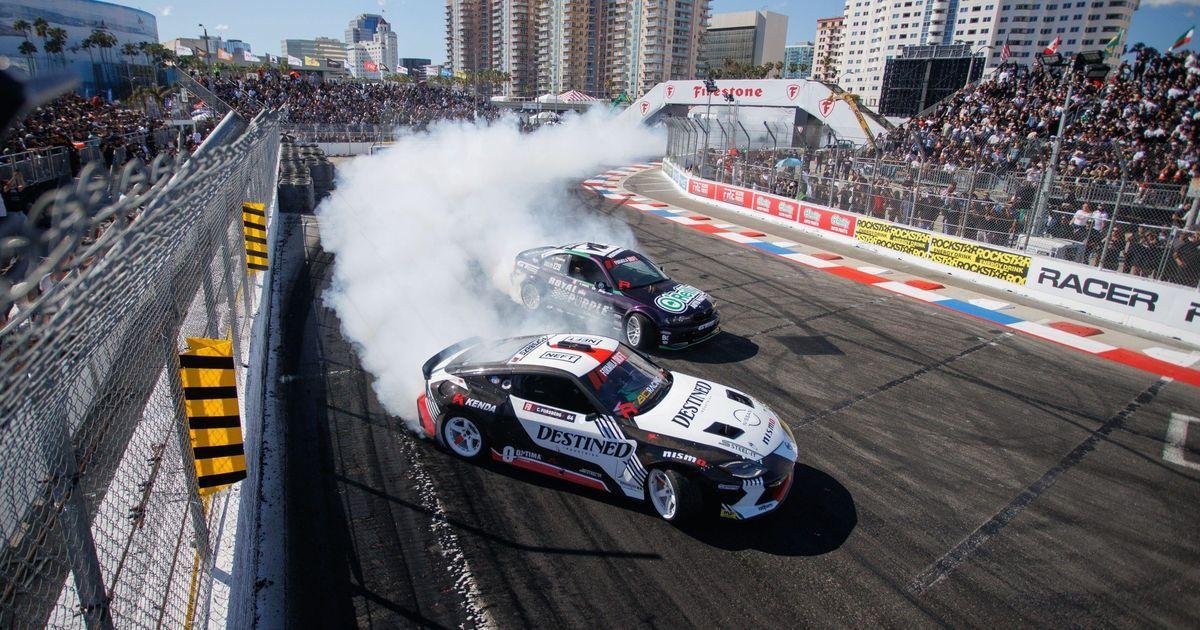
UDSM made its competitive debut at the Streets of Long Beach on April 10 and 11, running in what Formula Drift described as a supporting role during Top 32 competition rather than a full replacement for judged decisions. The headline result was a genuinely dramatic one: Conor Shanahan took the Round 1 win in a tight final against three-time FD PRO Champion Fredric Aasbo, driving a new car built by his new team, Jerry Yang Racing, in just his third season in the series.
But the more revealing storyline from Long Beach happened earlier in the bracket, and it says a lot about where UDSM’s limits actually sit.
When the Human Element Still Ruled: The Gushi-Shanahan Story
In Shanahan’s Top 32 battle against Ken Gushi, contact during Shanahan’s transition sent him into the wall near Zone 6. Gushi was judged to be at fault for the collision, which technically should have handed Shanahan the win outright once his team couldn’t repair the car in time to continue. Instead, the judges called for a One More Time rerun anyway, giving both drivers another shot. Shanahan’s team scrambled to patch the car back together, got it to the line, and then watched it break again on the way back to staging. By any technical reading of the rules, that should have ended things in Gushi’s favor.
It didn’t. Gushi and his spotter reportedly offered to rerun the battle regardless, extending the same kind of courtesy that had once been shown to them in a similar situation earlier in their careers. It’s a decision that cost nothing to make in theory and everything in practice: Gushi had effectively already won, and chose to put that result back on the table anyway. Shanahan went on to win the rematch and eventually the event. It’s hard to imagine a clearer illustration of what UDSM was never designed to touch. No amount of telemetry data governs whether a driver extends sportsmanship to a rival, and some of the most memorable moments of Formula Drift’s first UDSM-era event had nothing to do with the algorithm at all.
Mixed Reviews So Far
Online reaction to the new system after Long Beach has been genuinely split, with commentary from fans and drivers alike landing across the spectrum from cautiously optimistic to openly skeptical. Some of that discussion played out on Formula Drift’s own Outerzone podcast, where drivers who’d just competed under the new format shared their first real impressions. The broader online conversation has been pointed enough that it’s spawned its own wave of reaction content questioning whether the sport’s judging problems have actually been solved or just repackaged. A lot of the skepticism seems to center less on whether Line and Angle can be measured accurately, few people dispute that telemetry can track a car’s position and angle better than a human eye can, and more on whether reducing those categories to a number strips out context that judges used to weigh instinctively, like how a car got to that line or angle in the first place. Supporters of the change counter that separating Style into its own dedicated 20% is precisely what preserves that context, just in a narrower, more defensible box.
None of this is unusual for a one-event sample size. Automated judging has a mixed track record across other motorsports that have tried it, and Formula Drift’s leadership has been upfront from the start that this is, in their own words, a genuine gamble on technology in a sport that has always prided itself on being judged by people who drift themselves.
Other Storylines UDSM Shared the Spotlight With at Long Beach
- Ryan Tuerck announced that 2026 will be his final full season of Formula Drift competition, though he’s clear it isn’t a full retirement from the sport, just a step back from the year-round grind as he shifts focus to his 411 Works content and build projects. He’s still contesting all eight rounds this year in the Rain-X Toyota GR Corolla with Papadakis Racing.
- Rookie Cole Richards, fresh off a fifth-place PROSPEC finish last season, qualified 12th in his first PRO event and fought through Tommy Lemaire, Ryan Litteral, and Brandon Sorensen before falling in the Final 4 to eventual event winner Shanahan.
- Diego Higa, returning after sitting out 2025, qualified 17th and immediately became one of the bracket’s biggest threats, eliminating Dan Burkett in the Top 32 before pulling off one of the weekend’s biggest upsets by knocking out reigning champion James Deane in the Top 16.
- Veteran Aurimas “Odi” Bakchis debuted a new Feal Suspension / GT Radial / Subimods BRZ at Long Beach and looked comfortable immediately, a sign of things to come after he went on to win Round 3 in Orlando.
What to Watch as the Season Continues
- Whether UDSM actually reduces the frequency of contentious One More Time calls as more data accumulates, or whether moments like the Gushi-Shanahan battle keep happening regardless of what the telemetry shows.
- How driver and fan sentiment shifts over a full season rather than a single event. One round is a genuinely small sample size for judging whether a scoring overhaul this significant is working.
- Whether the broadcast integration of live telemetry actually changes how casual viewers follow tandem battles, or whether it ends up as background data most fans tune out in favor of watching the smoke.
- Whether Formula Drift adjusts the 80/20 automated-to-human split at all based on feedback from Long Beach and the rounds that follow, the way other motorsports have iterated judging systems mid-season when early data suggested changes were needed.
The Bottom Line
UDSM was built to solve a scheduling problem and, in the process, took on one of Formula Drift’s oldest and thorniest debates: how much of judging a fundamentally artistic, high-speed sport can actually be handed over to a machine. The early answer, at least after one event, is that automation has genuinely changed how qualifying works and given judges sharper tools during tandem battles, but it hasn’t come close to removing the human element from the sport’s most memorable moments. If anything, Long Beach proved the opposite: some of the biggest storylines of Round 1 were decided by sportsmanship and judgment calls that no amount of telemetry could have made for the people involved.
#FormulaDrift #driftnews #UDSM #drifting2026